

About Me
I am a Ph.D. student in the Intelligent Systems and Learning Laboratory (ISL Lab) at DGIST, advised by Prof. Daehee Park. My research interests lie in building reliable Embodied AI systems that can safely operate in complex environments shared with humans. I am particularly interested in learning and decision-making for intelligent agents, as well as understanding how their behaviors emerge and can be improved in real-world scenarios. I aim to connect algorithmic development with real-world evaluation toward reliable and practical embodied intelligence.
Warning
Problem: The current name of your GitHub Pages repository ("Solution: Please consider renaming the repository to "
http://".
However, if the current repository name is intended, you can ignore this message by removing "{% include widgets/debug_repo_name.html %}" in index.html.
Action required
Problem: The current root path of this site is "baseurl ("_config.yml.
Solution: Please set the
baseurl in _config.yml to "News
Publications
Unified Prediction and Planning via Conflict-Aware Disjoint Parameter Training
*, Seonae Jeon*, Giwon Lee*, Kuk-Jin Yoon†, Daehee Park† (* Equal contribution, † Corresponding authors)
European Conference on Computer Vision (ECCV) 2026
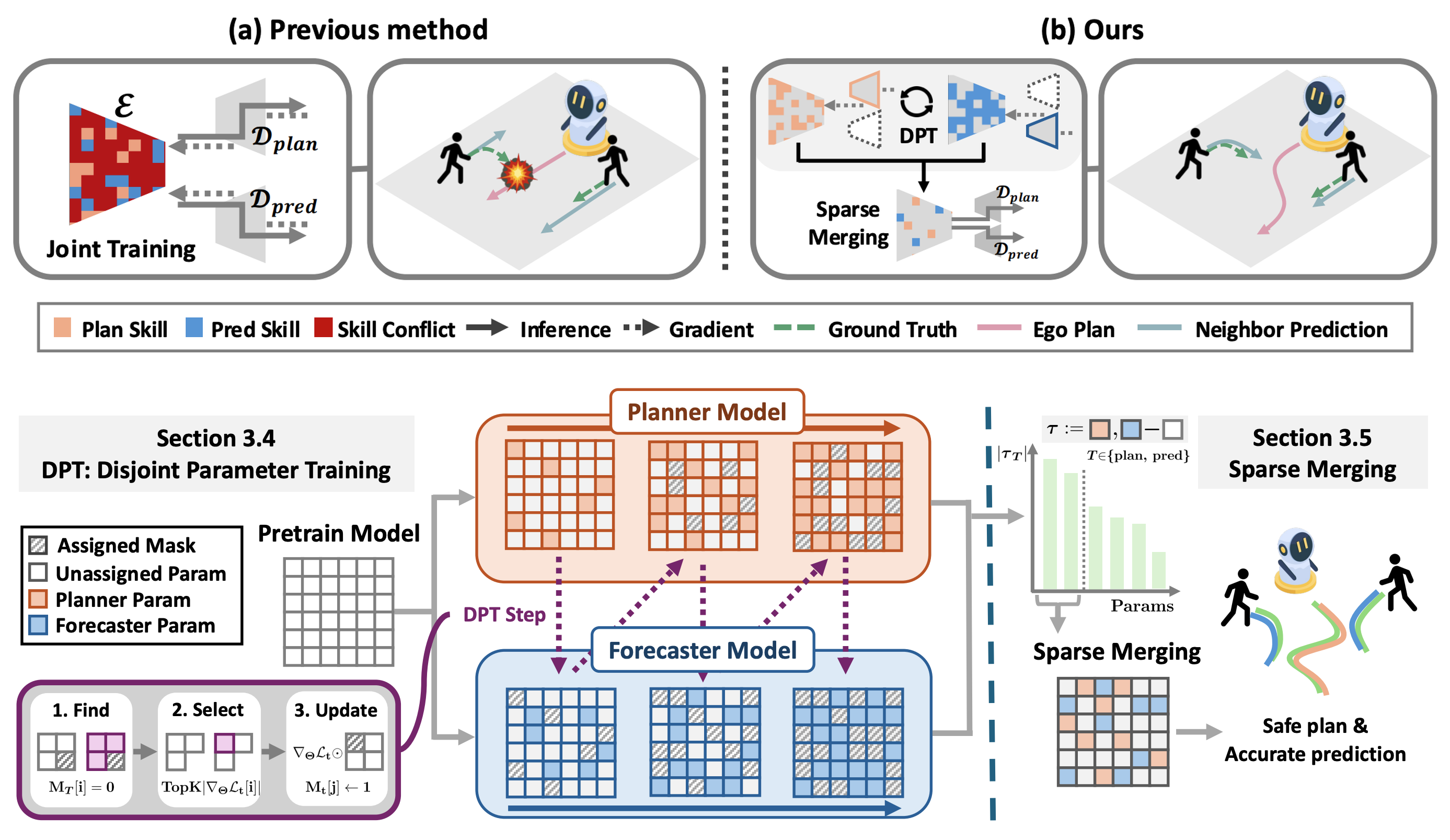
This work identifies Skill Conflict in compact unified models for motion prediction and planning and proposes Disjoint Parameter Training (DPT) to separate task-critical parameter regions. Combined with sparse model merging, DPT improves prediction accuracy and planning safety on crowd navigation benchmarks while maintaining a compact model.
Unified Prediction and Planning via Conflict-Aware Disjoint Parameter Training
*, Seonae Jeon*, Giwon Lee*, Kuk-Jin Yoon†, Daehee Park† (* Equal contribution, † Corresponding authors)
European Conference on Computer Vision (ECCV) 2026
This work identifies Skill Conflict in compact unified models for motion prediction and planning and proposes Disjoint Parameter Training (DPT) to separate task-critical parameter regions. Combined with sparse model merging, DPT improves prediction accuracy and planning safety on crowd navigation benchmarks while maintaining a compact model.